People searching for mel gibson directed movies will find a surprisingly short feature-film list. His directing career spans more than three decades, yet he has directed only six released theatrical features. Those movies range from intimate drama and historical epics to war films and a contained airborne thriller.
Direct answer: Mel Gibson has directed six released feature films: The Man Without a Face (1993), Braveheart (1995), The Passion of the Christ (2004), Apocalypto (2006), Hacksaw Ridge (2016), and Flight Risk (2025). His directing credits also include television work and announced future projects.
| Movie | Release year | Main genre | Notable lead |
|---|---|---|---|
| The Man Without a Face | 1993 | Drama | Mel Gibson, Nick Stahl |
| Braveheart | 1995 | Historical drama | Mel Gibson |
| The Passion of the Christ | 2004 | Biblical drama | Jim Caviezel |
| Apocalypto | 2006 | Historical action-adventure | Rudy Youngblood |
| Hacksaw Ridge | 2016 | Biographical war drama | Andrew Garfield |
| Flight Risk | 2025 | Suspense thriller | Mark Wahlberg, Michelle Dockery, Topher Grace |
Mel Gibson Directed Movies in Release Order
The six released mel gibson directed movies show major changes in scale, setting, and storytelling style. Several focus on historical periods, survival, faith, sacrifice, or characters facing extreme physical pressure. Flight Risk breaks that pattern by putting most of its action inside a small aircraft.
The filmmaker also acted in his first two theatrical directing projects. In his later features, he generally stayed behind the camera while other actors carried the central roles. That shift helped separate his work as a filmmaker from the action-star image built through earlier Hollywood roles.
The Man Without a Face (1993)
The Man Without a Face marked Gibson’s feature directorial debut in 1993. The drama follows Chuck Norstadt, a boy who wants help preparing for a military-school entrance examination. He turns to Justin McLeod, a former teacher living privately after an accident left his face scarred.
Gibson played McLeod, while Nick Stahl portrayed Chuck. The story is far smaller than the historical spectacles that later defined the director’s public reputation. It focuses on trust, isolation, education, and the assumptions people make about someone they barely know.
The movie also provides useful context for everything that followed. It showed an early interest in damaged central characters and difficult moral situations. Those themes would return on a much larger scale in several later productions.
Braveheart (1995)
Two years later, Braveheart transformed Gibson’s standing as a director. He also starred as William Wallace in the historical epic about Scottish resistance against English rule. Large battle scenes, romance, political conflict, and personal loss drive its nearly three-hour story.
The film became an important awards success in the United States. It won five Academy Awards, including Best Picture and Best Director. Those honors made the movie a defining point in Gibson’s filmmaking career.
Viewers should not treat the story as a documentary account of medieval Scotland. The production takes substantial dramatic liberties with historical people, relationships, events, and chronology. Its lasting importance comes more from its place in popular cinema than from strict historical accuracy.
Readers interested in filmmakers who also perform can compare this career path with Magazine Camp’s coverage of Keenen Ivory Wayans and his work across television and film. Both careers illustrate how performers can expand into directing, writing, and production.
The Passion of the Christ (2004)
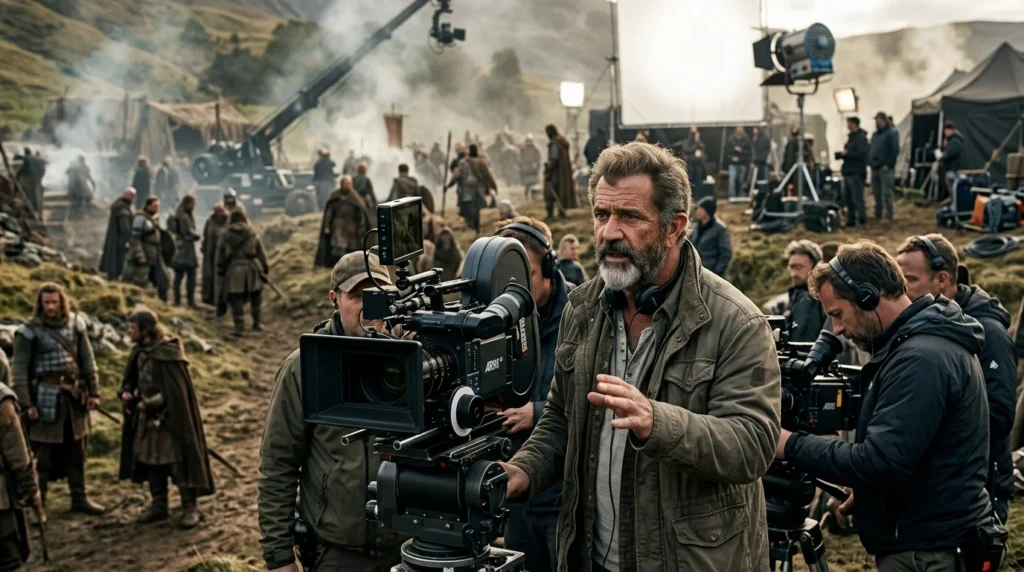
Gibson did not release another theatrical feature as director for nearly nine years. He returned with The Passion of the Christ, starring Jim Caviezel as Jesus. The film concentrates heavily on the final period before the crucifixion.
Language became one of the production’s most distinctive choices. Characters primarily speak reconstructed Aramaic and Latin rather than modern English. American audiences therefore encountered a major religious drama largely through subtitles.
The movie generated extensive discussion about its violence and its depiction of biblical events. It also became a major commercial success despite its unusual language choices and religious subject. Its reception remains central to discussions of faith-based cinema in the United States.
Apocalypto (2006)
Apocalypto moved the director from biblical history to a story set in Mesoamerica before sustained European colonization. Rudy Youngblood stars as Jaguar Paw, a young man captured after attackers raid his community. Much of the story becomes a desperate effort to survive and return to his family.
The production again avoided English as its principal spoken language. Its dialogue uses Yucatec Maya, continuing the director’s interest in using language to establish a distinct setting. Fast movement, physical danger, pursuit sequences, and environmental obstacles shape much of the movie.
Historical accuracy is more complicated than the film’s visual detail may suggest. Scholars and critics have challenged elements of its portrayal of Maya civilization and its compressed historical imagery. Viewers can therefore approach it as historical fiction rather than a literal reconstruction.
Hacksaw Ridge (2016)
A decade passed before another entry joined the list of mel gibson directed movies. Hacksaw Ridge arrived in 2016 and tells the story of U.S. Army medic Desmond Doss. Andrew Garfield plays Doss, whose religious beliefs led him to refuse to carry a weapon.
The story follows his military training and service during World War II. Later sections focus on the Battle of Okinawa and Doss’s efforts to rescue wounded soldiers. Together, they create a sharp contrast between his nonviolence and the destruction around him.
The film received six Academy Award nominations, including Best Picture and Best Director. It won Oscars for film editing and sound mixing. Garfield also received a Best Actor nomination for his performance.
For another look at American entertainers working across multiple parts of the industry, Magazine Camp profiles Keshia Knight Pulliam’s acting, producing, and directing career. The site’s broader Entertainment coverage also includes film, television, and celebrity profiles.
Flight Risk (2025)
Flight Risk marked another substantial change in scale. Released in 2025, the suspense thriller stars Mark Wahlberg, Michelle Dockery, and Topher Grace. Much of the story takes place aboard a small plane traveling across the Alaskan wilderness.
Dockery plays Deputy U.S. Marshal Madolyn Harris, who transports an important witness played by Grace. Wahlberg plays the pilot, whose role becomes increasingly dangerous as the flight continues. The restricted setting gives the movie a different visual structure from Gibson’s large historical productions.
The film also ended a long gap between his theatrical directing credits. His previous feature had been Hacksaw Ridge in 2016. That nine-year interval made the release notable even before audiences compared it with his earlier work.
How His Directing Style Changed Across Six Films
Looking chronologically reveals a clearer pattern than treating these films as unrelated titles. The first feature is an intimate character drama, while Braveheart expands into historical spectacle. Later productions move between religious history, survival action, war drama, and modern suspense.
Physical danger recurs throughout the filmography. Characters are often isolated, pursued, wounded, tested, or forced to make difficult decisions under severe pressure. The scale changes, but intense situations remain a recurring storytelling device.
Language is another distinctive element in two productions. The Passion of the Christ and Apocalypto rely heavily on languages most U.S. moviegoers don’t recognize. That choice asks viewers to follow images, performances, sound, and subtitles rather than conventional English dialogue.
Did Mel Gibson Direct Every Movie He Starred In?
No. Acting and directing are separate parts of his career, and his acting filmography is much larger. Famous acting titles such as Mad Max, Lethal Weapon, Signs, and The Patriot were directed by other filmmakers.
He directed and starred in The Man Without a Face and Braveheart. He did not take a leading acting role in the next four released theatrical features. This distinction helps prevent a common mistake when people search his extensive movie credits.
The difference also explains why online lists can vary dramatically in length. Some pages mix acting, producing, television, and directing credits together. A feature-directing list should separate those categories before counting titles.
What Is Next for His Directing Career?
The filmmaker has been publicly associated with additional directing projects. Current industry listings include planned follow-ups connected with The Passion of the Christ. Release plans for future productions can change, so keep announced titles separate from released films.
That distinction matters when counting his completed feature filmography. As of the released titles covered here, the theatrical list contains six movies through Flight Risk. Future releases can expand that total once they reach audiences.
For U.S. viewers revisiting these films, availability varies by subscription service, rental, purchase, and physical media. Streaming rights also change frequently between platforms. A current U.S. streaming guide is safer than an older availability list.
Frequently Asked Questions
How many mel gibson directed movies are there?
Flight Risk released six theatrical features in 2025. They begin with The Man Without a Face and include several historical or war-related productions. Television episodes and announced future projects are separate from that feature-film count.
What was his first movie?
He directed his feature debut, The Man Without a Face, in 1993. He also played the central adult character, Justin McLeod. The smaller drama arrived two years before the much larger production of Braveheart.
Did he direct Braveheart?
Yes, Gibson directed Braveheart and played William Wallace. The film was released in 1995 and became one of his best-known directorial achievements. It won Academy Awards for both Best Picture and Best Director.
Did he direct The Passion of the Christ?
Yes, he directed The Passion of the Christ, which was released in 2004. Jim Caviezel played Jesus in the biblical drama. The production became especially notable for its religious subject, graphic violence, and extensive use of ancient languages.
Did he direct Hacksaw Ridge?
Yes, Gibson directed Hacksaw Ridge, released in 2016. Andrew Garfield played WWII medic Desmond Doss. The movie earned six Academy Award nominations and won two awards.
What is his most recent released movie as director?
His most recent released theatrical directing credit is Flight Risk from 2025. The thriller stars Mark Wahlberg, Michelle Dockery, and Topher Grace. It arrived nine years after Hacksaw Ridge.
The Takeaway
Gibson’s directing career is much smaller than his acting career, but his films cover an unusually broad range of settings. The six released features move from personal drama to medieval warfare, biblical history, Mesoamerican survival, World War II, and modern suspense. Several also share recurring interests in sacrifice, survival, faith, violence, and people facing extreme circumstances.
For readers trying to identify the complete list of Mel Gibson-directed movies, the chronology is straightforward. Start with The Man Without a Face in 1993 and finish with Flight Risk in 2025. Future announced projects should be added only after their release status becomes clear.