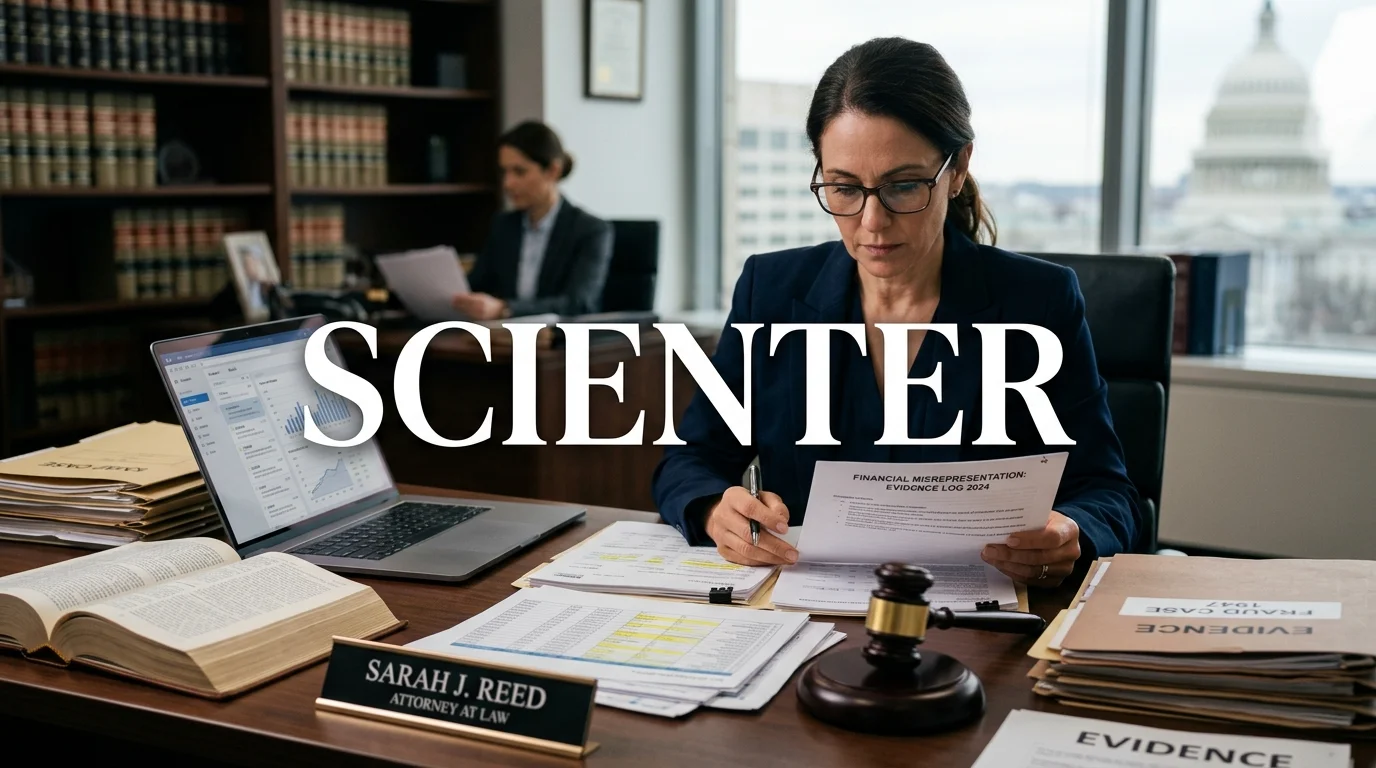
Scienter is the required mental state behind many fraud-based claims in United States law. It generally involves knowing wrongdoing, fraudulent intent, or conduct showing serious recklessness. The concept helps courts distinguish deliberate deception from an ordinary mistake.
Direct answer: The term describes a person’s knowledge or intent concerning wrongful conduct. In securities-fraud law, simple negligence generally does not satisfy the standard. Courts may accept sufficiently reckless conduct when the applicable law treats that behavior as equivalent to fraudulent intent.
| Key point | What it means |
|---|---|
| Basic concept | A culpable mental state involving knowledge, intent, or qualifying recklessness |
| Common legal setting | Fraud and federal securities litigation |
| Usually more than negligence | An honest mistake normally does not establish fraudulent intent |
| Proof | Often based on circumstances rather than a direct admission |
| Important Supreme Court cases | Ernst & Ernst v. Hochfelder, Aaron v. SEC, and Tellabs v. Makor Issues & Rights |
| U.S. securities rule | Certain federal antifraud claims require proof of the defendant’s required mental state |
Key takeaways
- Mental state can determine whether misleading conduct amounts to actionable fraud.
- Knowledge and deliberate deception provide strong evidence of the required state of mind.
- Serious recklessness can satisfy the standard in many federal securities cases.
- Ordinary carelessness usually falls below the required level for Rule 10b-5 fraud.
- Courts commonly rely on circumstantial evidence because direct proof of intent is rare.
- The precise standard depends on the statute, claim, jurisdiction, and facts involved.
What Does Scienter Mean in U.S. Law?
Scienter comes from a Latin word meaning to act knowingly. In modern American law, it describes a culpable state of mind connected with wrongful conduct. Cornell’s Legal Information Institute describes it as intent or knowledge of wrongdoing.
The concept does not create one universal test for every lawsuit or prosecution. Different statutes can require different forms of intent, knowledge, recklessness, or negligence. Courts therefore begin with the law governing the particular claim.
That distinction matters because harmful conduct does not always result from fraud. A person can make an inaccurate statement because of poor information or careless work. Fraud-based liability may require proof showing something more blameworthy than that mistake.
Why the Required Mental State Matters
Fraud law often examines both what happened and what the defendant understood. Two people can make identical false statements while possessing completely different mental states. One may believe the statement, while another may know it is false.
That difference can change the legal result. A negligence rule focuses mainly on whether reasonable care was used. A fraud standard may require proof of knowledge, deliberate deception, or sufficiently serious recklessness.
This principle is especially important in federal securities litigation. The Supreme Court has held that negligence alone does not satisfy Section 10(b) and Rule 10b-5. Those provisions require the higher mental-state showing associated with deceptive conduct.
Readers exploring other legal distinctions can also visit MagazineCamp’s Law section. That section covers U.S. legal rights, procedures, liability, and related topics. Comparing legal standards can make technical terms easier to understand.
Intent, Knowledge, Recklessness, and Negligence Compared
Legal mental states exist on a spectrum, although the exact categories depend on the governing law. Purposeful or knowing conduct generally reflects greater awareness than negligent behavior. Recklessness usually sits between deliberate action and simple carelessness.
| Mental state | General idea | Typical level of awareness |
|---|---|---|
| Intentional conduct | The person acts with a particular purpose | High |
| Knowing conduct | The person knows relevant facts or consequences | High |
| Recklessness | The person consciously or seriously disregards a known risk | Significant |
| Negligence | The person fails to use required reasonable care | Lower |
| Strict liability | Liability does not depend on proving a culpable mental state | Mental state may be irrelevant |
These categories should not be treated as interchangeable definitions. A statute may use its own wording or require a particular level of culpability. Courts also interpret those words within the specific legal context.
Cornell explains that criminal mens rea commonly includes purpose, knowledge, recklessness, and negligence. That broader criminal-law concept differs from the more specific fraud-related requirement discussed here. The exact relationship depends on the claim being examined.
Where This Requirement Appears in Securities Fraud

Federal securities law provides one of the most prominent examples. Section 10(b) and SEC Rule 10b-5 address deceptive practices involving securities transactions. The Supreme Court has required a culpable mental state for liability under those antifraud provisions.
The rule is also important under Section 17(a) of the Securities Act. In Aaron v. SEC, the Supreme Court distinguished between the three parts of Section 17(a). The Court required the higher mental-state showing for Section 17(a)(1).
The same decision reached a different result for Sections 17(a)(2) and 17(a)(3). Those provisions do not require that same showing in SEC enforcement actions. This difference shows why readers should identify the specific legal provision before applying a general definition.
Fraudulent intent is also only one part of a securities-fraud case. Plaintiffs may need to establish other elements required by the governing claim. Those issues can include a material misstatement, reliance, economic loss, and loss causation.
How Courts Determine Whether Fraudulent Intent Exists
A defendant rarely creates a document openly admitting an intention to deceive investors. Courts therefore permit mental state to be established through surrounding facts and circumstantial evidence. Conduct, communications, timing, and knowledge can all become relevant.
Evidence can include warnings that contradict a public statement. Internal reports may show what an executive knew before making a representation. Repeated behavior can also matter when it makes an innocent explanation less persuasive.
Courts still distinguish suspicious facts from sufficient legal proof. A bad business result does not automatically demonstrate fraudulent intent. An inaccurate prediction also does not automatically prove that its speaker knew it was false.
That evidence-based approach appears across many legal areas. MagazineCamp’s article on dog-bite liability and legal claims also explains how evidence affects liability disputes. Different claims require different proof, but documentation frequently shapes the outcome.
The Tellabs “Strong Inference” Rule
Federal private securities cases face an important pleading requirement under the Private Securities Litigation Reform Act. Plaintiffs cannot rely only on a vague assertion that a defendant intended fraud. Their complaint must contain particular facts supporting the required inference.
The Supreme Court addressed that standard in Tellabs, Inc. v. Makor Issues & Rights, Ltd. (2007). Courts must consider the allegations collectively and compare both culpable and innocent explanations. The fraud inference must be cogent and at least as compelling as an opposing innocent inference.
This does not mean plaintiffs need a confession before a case can continue. The Court recognized that intent can be inferred from allegations viewed together. Still, the statutory pleading standard requires more than a merely plausible suspicion.
This distinction matters for anyone reading about securities lawsuits. Alleging that a company issued incorrect information does not automatically satisfy federal fraud pleading rules. The complaint must connect its facts to the defendant’s required state of mind.
How Scienter Differs From Mens Rea
Mens rea is a broader term commonly associated with criminal intent. It describes the culpable mental state that a criminal offense requires. The required level can include purpose, knowledge, recklessness, or negligence.
The fraud-related concept discussed here is narrower and often arises in civil securities cases. It asks whether the defendant possessed the state of mind required by the specific fraud rule. That inquiry may focus heavily on knowledge, intent, and serious recklessness.
The two ideas overlap because both examine what someone knew or intended. They should not be treated as exact synonyms in every legal setting. Always read the statute and applicable court decisions before assuming one standard applies.
A Simple Example
Imagine a corporate officer tells investors that an important contract remains active. The officer has current documents showing the customer already terminated that agreement. A court could view those facts as evidence supporting knowing deception.
Now imagine another officer repeats the statement after receiving an outdated internal report. Nobody informed that person that the agreement had ended. The false statement might still create legal problems, but proving fraudulent intent becomes more difficult.
A third situation might involve clear warning signs that the officer deliberately ignores. Depending on the applicable legal standard, extreme recklessness can satisfy the mental-state requirement. Ordinary carelessness, by contrast, may be insufficient for a federal Rule 10b-5 fraud claim.
This example explains why evidence about knowledge matters. Courts examine what information existed and what the defendant knew when acting. Hindsight alone cannot establish the required state of mind.
Why the Difference Between Fraud and Negligence Matters
The distinction protects both sides of a legal dispute. Plaintiffs need a route to pursue deliberate deception supported by evidence. Defendants also should not automatically face fraud liability for every incorrect statement.
Different liability standards can also affect available claims and litigation strategy. A negligence-based provision may remain relevant where an intent-based claim cannot be established. The correct answer depends on the statute and the circumstances.
Similar rule-specific analysis appears throughout American law. MagazineCamp’s U.S. unemployment eligibility guide shows how outcomes change under different state rules. Legal terminology often becomes clearer once you identify the governing rule first.
Frequently Asked Questions
What does scienter mean in simple terms?
It means that a legal claim requires proof concerning the defendant’s culpable state of mind. That usually involves knowledge, fraudulent intent, or qualifying recklessness. The exact requirement depends on the law creating the claim.
Is recklessness enough to prove fraud?
Sometimes, particularly under federal securities-law standards applied by many courts. The SEC states that courts and the Commission have recognized recklessness as sufficient under applicable antifraud provisions. The required degree remains more serious than ordinary negligence.
Is negligence the same as fraudulent intent?
No. Negligence generally concerns a failure to exercise required care. Fraudulent intent involves a more culpable mental state, such as knowing deception or qualifying recklessness.
How can a plaintiff prove someone’s state of mind?
Direct evidence can help, but it is not always available. Courts can consider circumstantial evidence showing knowledge, conduct, warnings, communications, and timing. The relevant evidence depends on the legal claim and procedural stage.
Why is Tellabs important in securities cases?
Tellabs explains how federal courts evaluate the PSLRA’s “strong inference” pleading requirement. Courts compare the fraudulent inference with plausible innocent explanations. The culpable inference must be cogent and at least as compelling.
The Practical Takeaway
Mental-state requirements prevent every mistake from automatically becoming fraud. They force courts to examine what a defendant knew, intended, or consciously disregarded. That inquiry can determine whether a fraud claim survives and ultimately succeeds.
For readers, the safest approach is to identify the exact statute before drawing conclusions. Federal and state rules can impose different mental-state requirements. A qualified attorney can explain how those rules apply to a specific dispute.
MagazineCamp can continue making legal terminology easier through plain-English explanations and practical examples. Readers can use its broader law coverage to understand related doctrines and procedures. Legal information should support informed decisions, not replace individualized legal advice.