
If a U.S. immigration form, airline website, visa application, or government portal asks for a travel document number, the wording can be confusing. In many situations, the requested number is simply the passport number from the document you are using for travel, but that is not true in every case. Refugee travel documents, reentry permits, advance parole documents, visas, and I-94 records can all contain different identifying numbers.
The safest approach is to identify exactly which document the form is asking about before entering anything. A passport number, visa number, I-94 number, USCIS receipt number, and Alien Registration Number are separate identifiers even when several appear in the same immigration record. This guide explains how these numbers work in the United States, where to find the correct number, and how to avoid the most common mistakes.
Quick answer: A travel document number is the identifying number assigned to the passport or other travel document being used for a particular trip or immigration purpose. For most travelers using a passport, this will be the passport number, but USCIS-issued travel documents can have their own document numbers.
What Is a Travel Document Number?
The term describes a unique identifier attached to a specific passport or other government-issued travel document. Government agencies use the number to link a traveler to the specific document presented for travel, admission, or an immigration application. Because the identifier belongs to the document rather than functioning as a permanent personal number, it may change when a replacement or new document is issued.
The phrase becomes confusing because U.S. agencies do not always use it in exactly the same way on every form. For example, the Department of State’s DS-160 guidance refers to a combined “Passport/Travel Document Number” field and tells applicants to enter the number of the passport or travel document they will use to travel to the United States. USCIS forms may instead provide separate spaces for a passport number and a travel document.
Is a Travel Document Number the Same as a Passport Number?
A passport number can be a travel document number, but the two terms are not universally interchangeable. If your passport is the document you use for international travel and a form asks for your passport or document number, your passport number is usually the relevant identifier. If you are traveling with another qualifying document, however, the form may require the number printed on that document.
This distinction matters most on U.S. immigration forms that provide separate fields for the two numbers. Current USCIS forms show that applicants may be asked for a passport number, a separate document number, or a combined “passport or travel document number,” depending on what the agency needs. Reading the exact field label is therefore more reliable than assuming every reference to a travel document means a passport.
Quick Reference: Which Number Should You Use?
| Situation | Number generally requested |
|---|---|
| Traveling with a passport | Passport number |
| DS-160 asks for Passport/Travel Document Number | Number of the passport or travel document you will use to travel to the U.S. |
| CBP I-94 lookup after entering with a passport | Passport number used for that entry |
| USCIS form has separate passport and travel document fields | Complete the field that corresponds to the document actually used |
| Form specifically asks for a U.S. visa number | Visa number, not passport number |
| Form asks for an I-94 number | I-94 admission/record number |
| Traveling with a USCIS-issued travel document | Number assigned to that particular document, as applicable |
Where Is the Travel Document Number on a U.S. Passport?
For a person traveling on a U.S. passport, the passport number normally serves as the relevant identifier. CBP states that the passport number is near the top-right of the passport’s biographical information page and can also be found in the machine-readable zone. Travelers should copy the characters exactly as printed because confusing letters and numbers such as “O” and “0” can prevent government systems from finding a matching record.
Current Next Generation U.S. passport books also use an alphanumeric passport number: one letter followed by eight numbers. The U.S. Department of State says this passport number is perforated through the pages as a security feature. Older passports may have a different design, so the labeled passport-number field on the biographical page should remain your primary reference.
What the Format Looks Like
On the identification page, the number sits beside a label such as “Passport No.” In a current Next Generation U.S. passport book, it is one letter followed by eight digits, while many older books show nine digits with no letter at all.
Whatever the layout, the characters printed in that labeled field are what a U.S. form is asking for when it requests the number associated with that passport. Copy them from the document in front of you rather than relying on a number you remember or previously saved.
What About a Foreign Passport Used to Travel to the United States?
The same basic principle applies when a non-U.S. citizen uses a foreign passport to travel to the United States. The Department of State instructs DS-160 applicants to enter the number of the passport or travel document that they will actually use to travel to the United States, and the document must be valid and identify the traveler and nationality. That means an applicant with more than one passport should pay close attention to which passport they will use for the visa and trip.
CBP applies a similar approach when travelers retrieve an I-94 record online. The agency instructs passport users to enter the passport number in the document-number field and to use information from the same travel document used to enter the United States. Using details from a newly issued passport when the entry was recorded under an older passport can therefore prevent the system from locating the expected record.
What Is a USCIS Travel Document?
USCIS issues several types of documents that can authorize or facilitate travel for people in particular immigration situations. Current USCIS materials identify categories such as reentry permits, refugee travel documents, TPS travel authorization documents, and advance parole documents. These documents serve different purposes and should not be treated as interchangeable simply because they involve international travel.
A reentry permit, for example, is for certain lawful permanent residents or conditional permanent residents who need documentation to return after traveling abroad. A refugee travel document is available to qualifying refugees, asylees, and related permanent-resident situations, while advance parole can authorize a person to travel to a U.S. port of entry and request parole. Advance parole does not guarantee admission or parole because the port-of-entry decision remains separate. Families assembling documents in a hurry may also want our practical advice on supporting a loved one arrested on immigration grounds, which covers what to gather first.
Common USCIS Travel-Related Documents
- Reentry Permit
- Refugee Travel Document
- TPS Travel Authorization Document
- Advance Parole Document
- Certain combined employment authorization and advance parole documents
Each type can contain identifiers in addition to other immigration numbers belonging to the holder. The relevant number depends on the document and the wording of the form you are completing. If the document itself or the form instructions are unclear, verify the field using current USCIS instructions instead of substituting an A-Number or receipt number.
How to Find the Right Number on a USCIS Form
Start by reading the exact wording next to the blank field. Some USCIS forms place “Passport Number” and “Travel Document Number” in separate fields. Others combine them into one request for a “Passport or Travel Document Number.” That difference tells you whether the agency treats the two possibilities as alternatives or requests information about two separately identifiable types of documentation.
Form I-130, for example, includes separate passport-number and travel-document-number fields in the beneficiary’s entry-information section. Form I-485 instead asks for the “Passport or Travel Document Number Used at Last Arrival,” which emphasizes the document connected with that particular entry. These examples show why copying the same number into every immigration form without checking its wording can create unnecessary errors.
How It Differs From a Visa Number
A U.S. visa and a passport are different documents, even though the visa may physically appear inside a passport book. The passport identifies the traveler and the issuing nationality, while the visa generally relates to permission to travel to a U.S. port of entry for a particular visa classification and purpose. A form that specifically requests a visa number therefore asks for different information than one requesting a passport or document number.
This difference matters when completing USCIS forms because some forms request both types of information. Form I-485, for example, has fields for the passport or travel document used at the most recent arrival and, if applicable, the nonimmigrant visa number used during that arrival. Entering the passport number again in a field specifically designated for the visa number can therefore provide the wrong identifier.
How It Differs From an I-94 Number
An I-94 is the U.S. arrival/departure record associated with many noncitizens admitted or paroled into the country. Its record number is separate from the passport or other document number used during travel, even though both pieces of information can be connected with the same entry. When a form asks for an I-94 Arrival-Departure Record Number, you should not automatically substitute your passport number.
CBP’s official I-94 lookup site illustrates the distinction clearly because it asks travelers to provide document information, including the passport number used for entry, in order to locate their I-94 information. The passport number is therefore one search identifier, while the resulting I-94 record has its own identifying information. Keeping those numbers separate can help when completing USCIS applications that request both.
How It Differs From an A-Number
An Alien Registration Number, commonly called an A-Number, is another identifier used in the U.S. immigration system. It is not automatically the same as the number on a passport, reentry permit, refugee travel document, visa, or I-94 record. Applicants should enter an A-Number only when the form asks for an A-Number or when official instructions specifically direct them to use it for a particular document-search situation.
CBP may allow certain travelers who entered without a passport to use another identifier when searching for their I-94. CBP specifically notes examples involving some Border Crossing Card users and certain individuals whose entry was associated with an A-Number. Those exceptions do not turn the A-Number into a universal identifier for every immigration application.
Common Mistakes When Entering the Number
Small errors can cause problems because government databases often search for an exact match between the number and other biographical details. A person may have several government identifiers in front of them at the same time, which makes it easy to copy the wrong one. Checking the field label and the document connected with the relevant trip is usually the simplest way to avoid confusion.
Common mistakes include:
- Entering a U.S. visa number when the form asks for a passport number.
- Entering an I-94 number in a passport or travel-document field.
- Using an A-Number merely because it appears on an immigration document.
- Using the number from a renewed passport instead of the passport used for the relevant U.S. entry.
- Confusing the letter O with the number 0.
- Confusing the letter I with the number 1.
- Copying a document number from an old application without checking the original document.
- Assuming a passport number stays the same after renewal.
- Entering the USCIS receipt number from an application notice instead of the number printed on the actual travel document.
How to Enter the Correct Number Step by Step
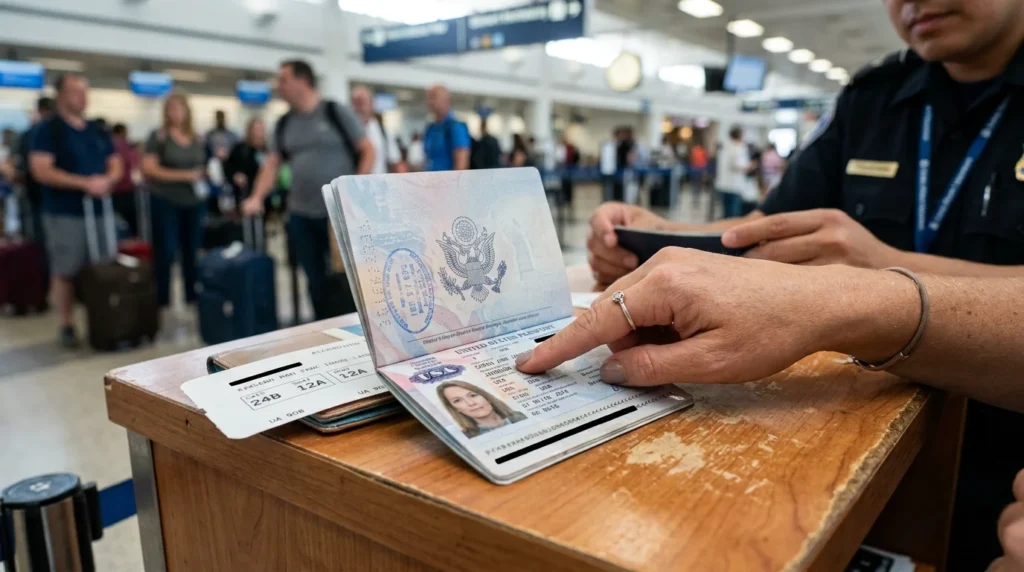
The easiest way to answer a travel-document field is to work backward from the application wording. Before copying any number, determine which trip, entry, passport, or immigration document the question refers to. This process is especially useful for people who have renewed a passport, hold multiple nationalities, or have received several immigration documents.
- Read the field exactly. Check whether it says passport number, travel document number, visa number, or I-94 number.
- Identify the relevant event. Determine whether the question concerns a future trip, your most recent U.S. arrival, or a specific previous entry.
- Find the document used for that event. Do not automatically use your newest document if the question concerns an older arrival.
- Copy the number exactly. Preserve letters, numbers, and their order as they appear on the document.
- Check the issuing country. Many forms ask for the country that issued the passport or travel document immediately after the number.
- Check the expiration date. Make sure the date matches the document number you entered.
- Review similar characters. Look carefully for combinations such as 0/O and 1/I before submitting the form.
- Use official instructions when uncertain. Government form instructions should take priority over assumptions based on another application.
What If You Renewed Your Passport?
A renewed or newly issued U.S. passport has a different passport number than your previous passport. The State Department specifically advises travelers that the number on a new passport will differ from the one on the previous passport. This means you may need to update saved travel profiles and other records after renewal.
An immigration form may still ask for the passport or travel document associated with an earlier U.S. entry. In that case, having a newer passport does not necessarily change the document information tied to the historical arrival. Read whether the form requests your current passport or the document used at last arrival before deciding which number to enter.
What If You Cannot Find Your Old Passport Number?
First check copies of the passport, previous visa applications, travel records, or other legitimate records you retained from the trip. If you are trying to retrieve an I-94, CBP warns that using information different from the passport originally used for entry may prevent retrieval. The agency provides additional assistance procedures when a traveler cannot retrieve the record using the original document information.
Avoid guessing a missing number because a nearly correct passport number can still point to no matching record. You should also avoid entering a current passport number merely to fill the field if the question clearly asks about a different historical document. When the missing information affects an immigration filing, consulting the applicable government instructions or qualified immigration counsel can be more appropriate than making an assumption.
Is the Number Sensitive Information?
Treat a passport or document number as sensitive identifying information. Airlines, immigration authorities, visa systems, and other legitimate travel services may require it, but that does not mean you should post it publicly or send it through untrusted websites. Travelers should verify that they are using an official government portal or a legitimate service before entering passport information online.
Keeping a secure copy of important travel-document details can nevertheless be useful if the original document is lost or stolen. Store those records in a protected location rather than an openly accessible note, social-media account, or public cloud link. If you lose or have a passport stolen, follow the reporting and replacement procedures of the issuing government.
Why the Exact Document Matters for U.S. Forms
Government forms often ask for travel-document information because it links an application to a specific international trip or U.S. admission record. That is why the issuing country, expiration date, arrival date, passport number, and travel-document number frequently appear together. Matching the correct number with the correct event makes the application easier to review and reduces inconsistencies between records.
This is also why no single number identifies every person in the U.S. as “my travel document number.” One person may have a passport number, an I-94 number, an A-Number, a visa number, and a USCIS-issued document number at the same time. The correct answer depends on which document the government form actually asks you to identify.
Frequently Asked Questions
Where do I find my travel document number?
If you are traveling with a passport, look for the passport number on the passport’s biographical information page. For U.S. passport holders, CBP identifies the passport number near the top-right of that page, and current Next Generation U.S. passports use an alphanumeric number. If you are using a USCIS-issued travel document instead, check the identifying number on that document and the instructions for the form you are completing.
Is my passport number my travel document number?
It usually is when your passport is the travel document the question refers to. For example, the DS-160 asks applicants to provide the number of the passport or travel document they will use to travel to the United States. However, someone traveling with another authorized document may need to provide that document’s number instead.
Is a visa number the same as a travel document number?
No, do not assume a visa number and a passport number are the same. USCIS forms can request the visa number separately from the passport or travel document number used during entry. Always use the number corresponding to the specific field rather than copying one identifier into both places.
Is an I-94 number a travel document number?
An I-94 record number is distinct from the passport or document number commonly used to locate the record. CBP asks travelers searching for an I-94 to enter information from the document used to enter the United States, including the passport number for most passport-based entries. A form that separately requests an I-94 number should therefore be completed using the I-94 information, not the passport number.
Does my travel document number change when I renew my passport?
Yes, a newly issued U.S. passport has a different passport number from the previous passport. The State Department specifically notes that the new number will be different after a new passport is issued. For forms about a previous U.S. arrival, however, you may still need information from the older passport used for that entry.
Can I use my A-Number as my travel document number?
Not as a general rule because an A-Number is a separate immigration identifier. Some CBP I-94 search situations allow certain travelers whose entry was associated with an A-Number to use it in the document-number field, but that is a specific exception, not a universal rule. If a USCIS application has separate fields for an A-Number and a document number, follow those labels rather than entering the A-Number twice.
What should I enter on the DS-160 for Passport/Travel Document Number?
Enter the number of the passport or travel document you will use to travel to the United States. The Department of State says that the document must still be valid and must identify you and your nationality. Applicants should use the information from the document they intend to travel with, not another passport or an unrelated immigration number.
Final Takeaway
A travel document number is best understood as the identifying number of the specific passport or other travel document relevant to your trip or immigration application. For most passport travelers, that means the passport number, but U.S. immigration records can also involve separate visa, I-94, A-Number, receipt number, and USCIS travel-document identifiers. Checking the exact field label and matching it with the document used for the relevant trip is the most reliable way to enter the right information.
For additional U.S.-focused explainers on government rules and legal terminology, readers can explore Magazine Camp’s Law coverage. Official government instructions should remain the primary source when completing an immigration or visa application because forms, editions, and requirements can change. When a document issue could affect immigration status, travel authorization, or reentry to the United States, tailored advice may also be appropriate.
Editorial note: This article provides general educational information and is not individual legal or immigration advice. Immigration requirements can depend on a traveler’s status, documents, travel history, and the particular form being filed. Readers should verify application-specific requirements through the U.S. Department of State, U.S. Customs and Border Protection, or U.S. Citizenship and Immigration Services before submitting official information.