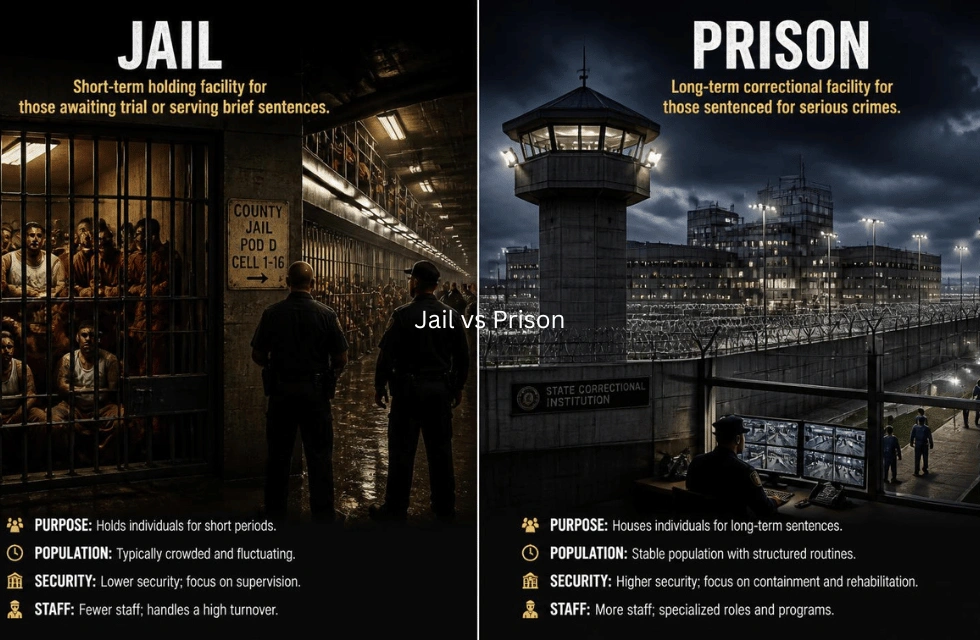
The two terms may sound interchangeable, but the U.S. correctional system uses them to refer to different types of custody.
Short answer: Jail vs prison mainly differs by purpose, stage of custody, length of stay, and who operates the facility. Local jails usually hold people awaiting trial or sentencing, as well as people serving shorter sentences. Prisons are longer-term state or federal facilities for convicted people, although definitions and rules can vary by state.
| Difference | Jail or local custody | Prison |
| Main purpose | Pretrial detention and shorter sentences | Longer post-conviction sentences |
| Typical operator | City, county, or other local authority | State or federal government |
| Custody status | Can include both unconvicted and convicted people | Usually includes people who have already been convicted |
| Typical length | Often less than one year | Often more than one year |
| Transfer role | May hold people awaiting transfer | Usually serves as the longer-term destination |
The Bureau of Justice Statistics uses this same basic distinction. It also notes that definitions can vary among states. That matters because the familiar one-year dividing line is a useful rule of thumb, not a universal legal standard.
Key Takeaways
- Local facilities commonly hold people before trial or sentencing.
- They can also house people serving shorter criminal sentences.
- State and federal prisons generally handle longer sentences after conviction.
- Local governments commonly operate short-term facilities, while state and federal governments operate prison systems.
- The one-year rule describes the usual pattern, but state definitions can differ.
- A person may spend time in local custody before being transferred after sentencing.
Jail vs Prison: The Difference in One Minute
The easiest way to understand the distinction is to look at where a person is in the criminal process. Someone can be taken into local custody soon after an arrest. If that person remains detained, the facility may hold them while the case moves toward trial, a plea, or sentencing. A conviction is not required for pretrial detention.
Prison usually comes later. It is generally associated with a conviction followed by a longer sentence. State systems house people sentenced under state law, while the federal correctional system handles federal sentences.
That means the difference is not simply about how serious a building looks. It is mainly about custody status, sentence length, and which level of government operates the facility.
Who Is Held in Local Custody?
A local jail can hold several groups of people at the same time. This is why describing everyone inside as a convicted criminal would be inaccurate.
People may be there because they are:
- waiting for a court hearing or trial;
- waiting to be sentenced after a conviction or plea;
- serving a relatively short sentence; or
- waiting to be transferred to another correctional institution.
The distinction is especially important after an arrest. Being detained does not itself prove guilt. Arrest, pretrial detention, conviction, and sentencing are separate stages of the legal process.
Magazine Camp’s guide to supporting a loved one arrested for immigration-related reasons also shows why the first days of custody can involve practical legal and family decisions before a case is resolved.
Who Goes to State or Federal Prison?
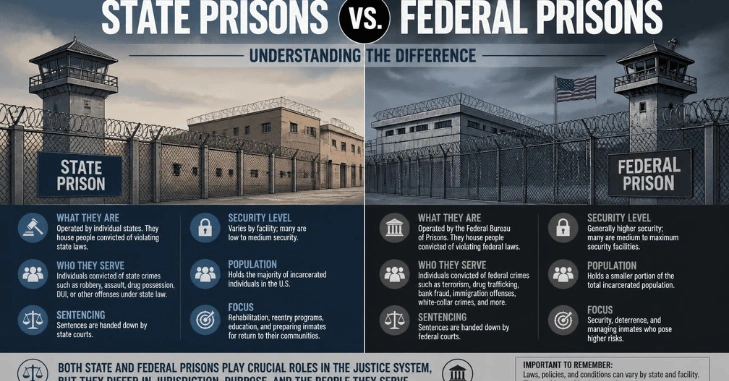
Prisons are designed mainly for longer-term incarceration after conviction. They typically hold people serving longer sentences imposed under state or federal law. State and federal systems are separate. A state conviction is normally handled within that state’s correctional system, while a federal sentence is handled within the federal correctional system.
The United States does not have a single correctional system controlling every person in custody. Federal, state, and local governments operate different parts of the system under different laws. This is one reason a facility’s name alone does not tell you everything about a person’s case.
Does the One-Year Rule Always Apply?
You will often see a simple formula:
Less than one year usually means local custody. More than one year usually means prison.
That description is useful, but definitions can vary by state.
A sentence of exactly twelve months should therefore not be treated as a nationwide legal test. State statutes, sentencing rules, facility arrangements, and transfer policies can determine where someone serves a sentence.
The better approach is to treat one year as a general correctional distinction and then check the rules in the state involved.
What Happens From Arrest to a Prison Transfer?
The route through the system becomes easier to understand when viewed as a timeline.
- Arrest and booking. Law enforcement takes the person into custody and completes the booking process.
- Pretrial stage. A detained person may remain in local custody while the criminal case continues.
- Plea or trial. The case may result in a guilty plea, a conviction, a dismissal, an acquittal, or another legal outcome.
- Sentencing. If the person is convicted and sentenced to incarceration, a judge determines the sentence.
- Placement or transfer. A person serving a shorter sentence may remain in local custody. A longer state or federal sentence typically results in placement in the appropriate correctional system.
This timeline also explains why news reports sometimes say someone is being held locally even after a conviction. A person may still be waiting for sentencing or transfer.
Legal events often have several stages rather than one decisive moment. Magazine Camp uses a similar step-by-step approach in its guide to what to do immediately after a car accident, where early actions can affect what happens later.
Does a Felony Always Mean Prison?
“Felony equals prison” and “misdemeanor equals county jail” are useful shortcuts, but they should not be treated as absolute rules. Prisons typically house people convicted of felonies who are serving longer terms. Local facilities commonly hold people serving shorter misdemeanor sentences. Sentencing still depends on the law governing the particular offense and case.
Probation, suspended sentences, local custody, and other outcomes can affect where a person serves a sentence. The offense label is therefore only part of the answer. The imposed sentence and jurisdiction also matter.
Why Do People Use the Words Interchangeably?
Everyday English is less precise than correctional terminology. In ordinary conversation, people often use jail and prison interchangeably even though the terms have narrower distinctions in legal and correctional contexts. The formal distinction is more useful when discussing a court case, sentence, or correctional placement.
That explains phrases such as “sent to jail” in casual conversation, even when the person will ultimately serve a long sentence in a state or federal prison.
For legal writing, news reporting, or understanding a real case, it is better to identify the person’s stage in the legal process and the type of facility involved.
What to Remember
The fastest way to tell the two systems apart is to ask three questions: Has the person been convicted? How long is the sentence? Which level of government controls the facility? Those questions usually explain the placement more accurately than the crime label alone.
If you are researching a real criminal case, verify the rules in the state or federal jurisdiction involved. A criminal defense lawyer can explain how local sentencing and transfer rules apply to a specific person.
For more plain-English legal explainers, browse Magazine Camp’s Law section.
Conclusion
The difference between jail vs prison becomes much clearer when you look at three things: where someone is in the criminal process, how long they are expected to remain in custody, and which level of government operates the facility. Jails are generally local facilities used for pretrial detention, people awaiting sentencing or transfer, and shorter sentences. Prisons generally handle longer-term incarceration after conviction through state or federal correctional systems.
The one-year distinction is a helpful rule of thumb, but it should not be treated as an absolute rule across every U.S. jurisdiction. State laws, sentencing requirements, and correctional policies can affect where someone is held.
Frequently Asked Questions
Think short-term or pretrial custody versus longer-term custody after conviction. Local facilities commonly handle pretrial detention and shorter sentences. State and federal prisons generally hold people serving longer sentences. State definitions can differ.
Yes. Local detention facilities routinely hold people awaiting trial or sentencing. Being detained before trial does not mean a court has found the person guilty.
Yes. A person may remain in local custody while awaiting trial, sentencing, or transfer. After receiving a sentence that requires placement in a state or federal correctional facility, that person may be transferred.
No. More than one year is a common distinction used to describe prison sentences, but it is not an exception-free rule in every jurisdiction. Definitions and placement rules can vary by state.
Local authorities generally operate county detention facilities. State governments and the federal government normally administer prisons. The precise agency structure depends on the jurisdiction.
No single rule applies to every facility. Security arrangements depend on the institution, population, classification system, and jurisdiction. The more reliable distinction involves the facility’s purpose and the expected length of custody.