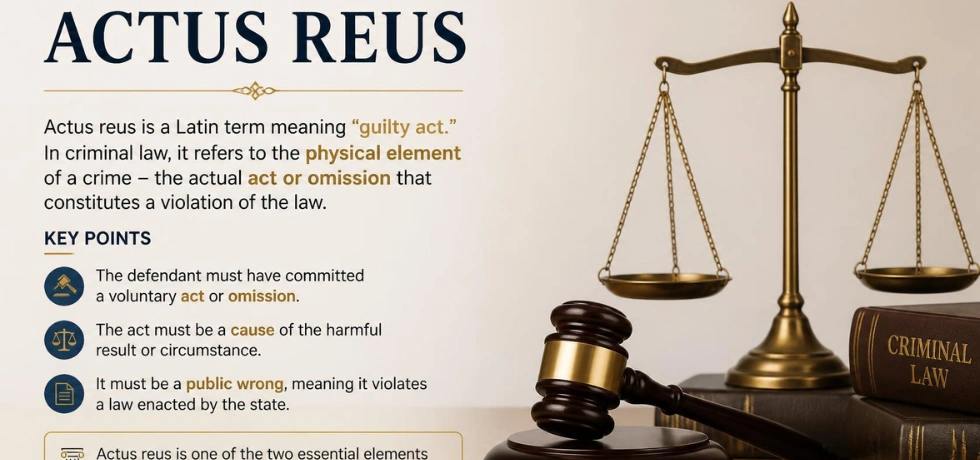
Actus reus is the conduct side of criminal liability: the physical act, prohibited omission, or other legally recognized conduct connected to an offense. In U.S. criminal law, the prosecution generally must prove the conduct required by the statute, along with any other required elements. A bad thought or harmful intention by itself normally does not establish a completed crime. You might also like Scienter Meaning in U.S. Law.
| Key point | What it means |
| Basic meaning | The physical or external component of a criminal offense |
| Voluntary conduct | Criminal liability ordinarily requires conduct that includes a voluntary act. |
| Omission | Failure to act may qualify when a legal duty requires action. |
| Possession | Some laws treat knowing possession or control as sufficient conduct |
| Mens rea | The mental-state element, separate from the physical conduct |
| Burden of proof | Prosecutors must prove the required elements beyond a reasonable doubt. |
| U.S. variation | The exact conduct required depends on the governing criminal statute. |
Direct answer: Actus reus is the physical or external component of a crime: a voluntary act, or in limited situations a failure to act when the law imposes a duty. U.S. criminal liability usually requires prosecutors to prove this conduct together with the other elements required by the specific offense.
Key Takeaways
- Criminal law generally requires more than a thought, condition, or intention.
- A voluntary bodily movement is the clearest form of criminal conduct.
- An omission can lead to liability when a recognized legal duty exists.
- Possession may satisfy the conduct requirement under particular statutes.
- The required mental state is a separate question from the prohibited conduct.
- The wording of the federal or state statute always matters.
What Actus Reus Means in U.S. Criminal Law
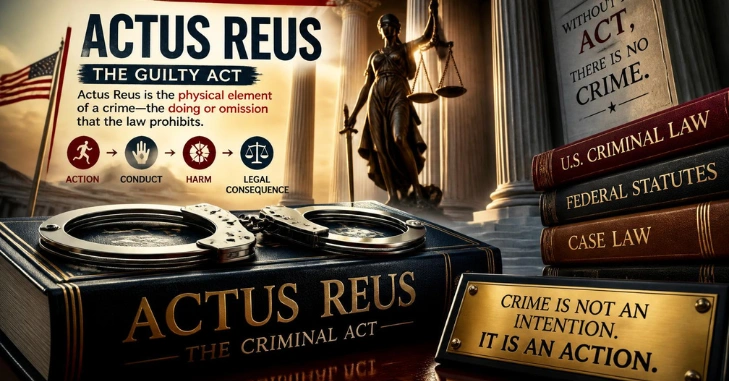
The Latin phrase is commonly translated as “guilty act,” but that shorthand can be narrower than the legal analysis. Cornell’s Legal Information Institute describes the concept as an act or omission forming the physical elements required by a criminal statute. The actus reus statute therefore provides the starting point for deciding what conduct the government must prove.
The phrase also does not have one universal scope in every legal discussion. A U.S. Department of Justice brief notes that some authorities focus on the defendant’s voluntary conduct, while others use the term more broadly for external circumstances and results. For a real criminal charge, it is safer to identify each statutory element than to rely on the Latin label alone. The same caution applies to the everyday labels attached to a criminal case, and Magazine Camp’s guide to jail versus prison in the U.S. criminal justice system shows how much can turn on two words that people often treat as interchangeable.
The Voluntary Act Requirement
A basic criminal-law principle is that the relevant conduct normally must include a voluntary act. Cornell explains that an involuntary movement, such as a reflex, does not satisfy the ordinary voluntary-act requirement. This rule helps distinguish behavior a person controls from bodily events that happen without conscious choice.
Common examples used to explain involuntary movement include:
- a reflex or convulsion;
- movement during unconsciousness;
- movement while asleep; and
- certain conduct occurring without conscious bodily control.
The influential Model Penal Code likewise bases criminal liability on conduct that includes a voluntary act or a legally significant omission. Its approach has influenced American criminal-law analysis, although it is not itself a nationwide criminal statute. Federal and state law can define offenses differently, so the specific jurisdiction still controls.
Voluntariness also should not be evaluated by isolating a single second from a longer course of conduct. An involuntary movement at the moment of harm may raise an important issue, but earlier voluntary behavior can still matter under the charged statute. Courts therefore examine what conduct the law prohibits and which actions are legally connected to that offense.
When a Failure to Act Can Become Criminal Conduct
Criminal responsibility does not always require an affirmative movement such as striking someone or taking property. A failure to act can satisfy the conduct requirement when the defendant had a legal duty to take action and failed to perform it. Without such a duty, mere failure to help another person does not automatically create criminal liability.
Recognized sources of a legal duty can include:
- a statute requiring action;
- a contractual obligation;
- a special relationship, such as certain parental duties;
- voluntarily assuming responsibility for another person’s care; or
- creating a dangerous situation that then requires corrective action.
The existence of a duty is only part of the analysis. The prosecution must still establish the other elements required by the offense, including any required mental state, causation, or prohibited result. State statutes can also create specific duties, which means omission cases may turn heavily on local law.
How Possession Can Satisfy the Conduct Requirement
Possession is different from an obvious physical movement because a person may remain in possession without continuously doing something. The Model Penal Code treats possession as an act when a person knowingly obtained or received the item or remained aware of control long enough to end that possession. This approach connects liability to a meaningful period of knowing control rather than to a purely passive condition.
The exact rule depends on the offense and jurisdiction. A possession statute may contain separate requirements concerning knowledge, the nature of the item, location, or the type of control exercised over it. Readers should therefore avoid assuming that physical proximity to an object automatically proves criminal possession.
Actus Reus vs. Mens Rea: What Is the Difference?
The conduct element concerns what happened in the external world, while mens rea concerns the mental state required for the offense. U.S. criminal statutes may require a person to act purposely, knowingly, recklessly, negligently, or under another specified standard. The two concepts answer different questions and usually must be analyzed separately.
| Question | Conduct element | Mens rea |
| Main focus | What the person did or failed to do | What mental state accompanied the conduct? |
| Typical issue | Was the conduct voluntary or legally sufficient? | Was the person purposeful, knowing, reckless, or negligent? |
| Example | Taking another person’s property | Knowing or intending that the property belongs to another |
| Evidence | Actions, physical evidence, recordings, witnesses | Statements, circumstances, behavior, and reasonable inferences |
| Can rules vary? | Yes, according to the statute | Yes, according to the statute |
The required conduct and mental state usually must connect in the way the offense demands. Criminal law often describes this relationship as concurrence, meaning the required state of mind accompanies the legally relevant conduct. A person cannot ordinarily be convicted simply because prosecutors prove a bad intention at one time and unrelated conduct at another.
Strict-liability offenses change part of this framework because they may dispense with a particular mens rea requirement. They do not normally mean that the government can punish a person without proving the prohibited conduct specified by the law. Cornell describes strict liability as liability for committing the relevant action regardless of the defendant’s intent or mental state.
Why Status and Conduct Are Legally Different
U.S. constitutional law has also drawn a distinction between criminalizing conduct and criminalizing a person’s mere status. In its 1962 decision in Robinson v. California, reported at 370 U.S. 660, the Supreme Court struck down a California law that allowed punishment based on the status of narcotics addiction rather than requiring a prohibited act. The Court distinguished being in a condition from committing conduct the state could lawfully prohibit.
That distinction remains relevant, but later cases show that laws directed at conduct can still apply to people who share a particular status. In its 2024 City of Grants Pass v. Johnson decision, the Supreme Court emphasized that Robinson prohibited criminalizing the mere status of addiction while distinguishing ordinances regulating actions. The practical question is therefore what behavior the statute makes unlawful, not only who the defendant is.
Thoughts are similarly different from prohibited conduct. Someone may imagine an unlawful act without committing the physical element of a completed offense. Separate crimes such as attempt or conspiracy have their own statutory elements, so they should not be confused with punishment for a private thought alone.
A Four-Question Test for Identifying the Criminal Act
A simple framework can make criminal-law problems easier to read. Start with the statute rather than assuming that every offense requires the same kind of physical behavior. Then separate the external conduct from questions about intention or knowledge.
- What conduct does the statute prohibit? Identify the act, omission, possession, circumstance, or result described in the law.
- Was the relevant conduct voluntary? Look for a conscious action rather than a reflex or uncontrolled bodily movement.
- If the case involves inaction, was there a legal duty? Determine why the defendant was legally required to act.
- What separate elements remain? Check the required mental state, circumstances, causation, and result.
Consider a straightforward theft example. Physically taking merchandise may supply the prohibited conduct, while the defendant’s knowledge or intent concerns the mental element. The prosecutor must still prove the elements contained in the applicable theft statute rather than merely showing that an object changed hands.
This framework is useful because criminal cases move through several separate stages and legal questions. Arrest, pretrial detention, conviction, sentencing, and incarceration are distinct events that should not be treated as interchangeable. The same attention to separate legal elements helps prevent confusion when analyzing a criminal charge.
Why the Conduct Element Matters in a Real Criminal Case
The prosecution carries the burden of proving the elements of a charged crime beyond a reasonable doubt. That means a dispute about whether the legally required conduct occurred can be decisive even when other facts appear suspicious. Cornell’s criminal-law overview identifies conduct, mental state, and causation among the basic components commonly examined in criminal cases.
For defendants and families, the practical lesson is to focus on the exact charge and jurisdiction rather than on a general legal definition. Magazine Camp’s resource for supporting someone facing an immigration-related arrest also stresses the importance of understanding charges, court dates, and legal rights. Those case-specific details matter far more than assuming that every criminal accusation follows an identical formula.
A criminal defense attorney can analyze how the governing federal or state statute applies to particular facts. This article explains a general legal principle and is not individual legal advice. For more plain-English coverage of legal processes and rights, readers can browse Magazine Camp’s Law section.
What U.S. Readers Should Remember
The “guilty act” idea prevents criminal liability from resting solely on an undesirable thought or personal condition. In the ordinary case, the government must identify legally prohibited conduct that satisfies the offense charged. That conduct may take the form of a voluntary action, qualifying omission, possession, or another statutorily defined physical element.
The statute remains the most important source because American criminal law varies across federal and state jurisdictions. A general definition can show you what question to ask, but it cannot replace the elements written into the applicable law. When reviewing a real case, identify the prohibited conduct first and then examine the required mental state and remaining elements separately.
Conclusion
Understanding actus reus is essential to understanding how criminal liability works under U.S. law. The term generally refers to the physical or external component of an offense, which may involve a voluntary act, a legally significant omission, possession, or another form of conduct identified by a criminal statute. A harmful thought, intention, or personal condition alone is generally not enough to establish the conduct element of a completed crime.
Frequently Asked Questions
What does actus reus mean in simple terms?
It means the physical or external part of a crime, often described as the “guilty act.” It can involve an affirmative action and, in defined situations, a failure to perform a legal duty. The precise conduct that must be proven comes from the law defining the offense.
Can failing to act be a crime?
Yes, but criminal liability for an omission generally requires a legal duty to act. That duty can arise from a statute, contract, special relationship, assumed responsibility, or creation of a dangerous situation. The prosecution must also prove the other elements required by the particular offense.
Do involuntary movements count as criminal acts?
An involuntary movement ordinarily does not satisfy the voluntary-act requirement by itself. Reflexes are a standard example, and American criminal-law authorities distinguish controlled behavior from movements outside conscious control. A court may still examine earlier voluntary conduct and the precise wording of the offense.
Does strict liability mean no physical conduct is required?
No. Strict liability generally removes or reduces the need to prove a particular guilty mental state, rather than eliminating the conduct required by the offense. Prosecutors still have to establish that the defendant committed the action or other physical element specified by the applicable law.